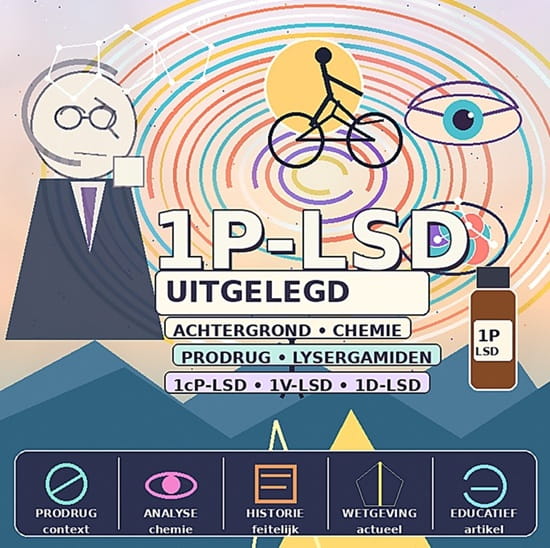

This page is intended as an informative overview. We discuss the background, chemical context, history, and related variants such as 1cP-LSD, 1V-LSD, and 1D-LSD. We do not provide instructions for use, dosage recommendations, or make any medical or therapeutic claims.
In a nutshell: What is 1P-LSD?
1P-LSD is a compound related to LSD in which a propionyl group has been added to the nitrogen position of the LSD molecule. That small modification makes 1P-LSD chemically distinct from LSD, while it still clearly belongs to the lysergamide family.
In scientific and analytical contexts, 1P-LSD is often discussed as a so-called prodrug. This means that, under certain conditions, a substance can be converted into another active compound. In the case of 1P-LSD, the discussion primarily centers on its conversion to LSD. This makes 1P-LSD of interest for analytical research, forensic chemistry, and the broader discussion of new psychoactive substances.
Important: “prodrug” is a pharmacological term. It is not a recommendation for use and does not imply anything about safety, suitability, or legal status.
Where does 1P-LSD come from?
1P-LSD became better known in the European research chemical market around the mid-2010s. The substance appeared during a period when many new psychoactive substances were emerging as chemical variants of existing, better-known compounds.
The principle behind this is not unique to 1P-LSD. In the world of research chemicals, existing molecules are sometimes modified by adding or altering a small chemical group. This results in a related substance with its own name, its own analytical profile, and sometimes a different legal status.
1P-LSD involves a propionyl group. This addition makes the molecule different from LSD, but the basic structure remains recognizably similar. It is precisely this balance between similarity and difference that has made 1P-LSD a much-discussed compound within the lysergamide niche.
Why did 1P-LSD become well-known?
1P-LSD has attracted attention primarily because it lies at the intersection of chemistry, legislation, and analytical research. It is not an entirely new chemical family, but a derivative of a very well-known lysergamide.
For researchers and collectors in this niche, such materials are interesting because they demonstrate how small structural changes can raise big questions:
How do you identify a substance analytically?
How does an analog relate to the original molecule?
When does a new connection fall under existing legislation?
How do laboratories handle variants that are very similar to one another?
These questions make 1P-LSD not only a product name, but also an example of how rapidly the world of new psychoactive substances and regulations is evolving.
See also
Is microdosing legal?
Microdosing
Truffles, 1p-LSD spray, and 4-HO-MET.
Magic truffles
Cultivated with care to perfection.
Botanicals & Fragrances
Lotus, caapi, smokes, scents, and more.
Stamps
1p-LSD and AL-LAD stamps.
Research compounds
Lysergamides and tryptamines.
What does “prodrug” mean in the context of 1P-LSD?
A prodrug is a substance that only acquires its pharmacological significance after being converted into another substance. In the case of 1P-LSD, it is often discussed in the literature that the propionyl group can be cleaved off, resulting in the formation of LSD.
In simple terms: 1P-LSD is considered a compound that is chemically similar to LSD and can be converted into LSD under certain biological or analytical conditions.
This makes the substance relevant for laboratory research and forensic analysis. At the same time, it is important to remain cautious: the term “prodrug” does not mean that all risks, effects, purity, or legal aspects are automatically predictable. New psychoactive substances may be assessed differently depending on the batch, region, and context.
1P-LSD and the Law: Why Small Differences Matter
One of the reasons 1P-LSD gained notoriety is the way legislation often deals with substances. In many countries, substances were listed individually for a long time. When a substance was not literally listed on such a list, there was sometimes room for related variants with a minor structural modification.
That is precisely the broader story behind many research chemicals: chemical innovation outpaced traditional substance-specific legislation.
In recent years, more and more countries have therefore opted for broader substance categories or analogous legislation. This allows not only individual substances but also entire families of related compounds to be subject to regulation. As a result, the legal status of 1P-LSD and related lysergamides may vary by country and change over time.
Therefore, always check the most up-to-date product information and local regulations. This page is for informational purposes only and does not constitute legal advice.
Related compounds and derivatives of 1P-LSD
Following the introduction of 1P-LSD, several related lysergamides appeared on the market or were mentioned in the scientific literature. These are often compounds in which the same basic structure is modified by adding a different group to the molecule.
Well-known names in this family include:
1cP-LSD
1cP-LSD stands for 1-cyclopropionyl-LSD. This compound is often regarded as a later variant within the same line of research chemicals. Like 1P-LSD, 1cP-LSD is discussed in scientific contexts as a potential prodrug of LSD.
1B-LSD
1B-LSD is a butyryl variant. This substance also belongs to the group of N1-acyl-lysergamides and is compared to 1P-LSD and LSD in an analytical context.
1V-LSD
1V-LSD, also known as Valerie in some niche contexts, is a newer lysergamide variant. The name refers to its valeryl structure. Here, too, interest centers primarily on chemical similarity, analytical identification, and regulatory issues.
1D-LSD
1D-LSD emerged as the next name in the series of LSD analogs. As with many new lysergamides, the focus is on structural modifications and how legislation and analysis respond to them.
ALD-52
ALD-52, also known as 1-acetyl-LSD, is an older related compound. This substance is often mentioned in discussions of the history of N1-substituted lysergamides.
These names are relevant because searchers often look not only for 1P-LSD, but also for similar terms such as 1cP-LSD, 1V-LSD, 1D-LSD, 1B-LSD, and ALD-52. Together, they form a broader topic within the lysergamide category.
What makes 1P-LSD chemically interesting?
What makes 1P-LSD interesting is primarily the small change to a well-known molecule. Chemically speaking, the difference is subtle, but analytically and legally, such a difference can make a big difference.
It is important for laboratories to be able to distinguish 1P-LSD from LSD and other lysergamides. Techniques such as chromatography, mass spectrometry, and NMR analysis are used for this purpose. Such methods help to better understand the identity, purity, and structure of a compound.
For policymakers, 1P-LSD is an example of the broader cat-and-mouse game between new molecules and substance-specific legislation. As soon as one substance is regulated, related variants may emerge that must be reevaluated.
For interested readers, 1P-LSD demonstrates above all just how complex the intersection between chemistry, regulation, and culture can be.
Is 1P-LSD the same as LSD?
No. 1P-LSD and LSD are not the same molecule. 1P-LSD is a derivative with an additional propionyl group. As a result, it has a different chemical identity.
However, the substances are closely related. That is precisely why 1P-LSD is often discussed in relation to LSD, especially when it comes to prodrug research, analytical detection, and legal classification.
It is important to choose your words carefully: 1P-LSD is not another name for LSD, but a related lysergamide that can be converted into LSD under certain conditions.
Why is there so little reliable public information about 1P-LSD?
Much of the information about 1P-LSD comes from analytical chemistry, forensic publications, and niche markets. There is less extensive, long-term public data available than for better-known substances. Therefore, caution is important.
Online experiences, forums, and anecdotes are not the same as controlled research. They often lack information about composition, context, purity, combination use, and individual differences. Therefore, it is still wise to rely primarily on reliable analytical sources and up-to-date product information.
Summary
1P-LSD is an LSD-related lysergamide that became best known within the research chemical niche. The compound is distinguished by a propionyl group attached to the molecule and is often discussed in scientific contexts as a potential prodrug of LSD.
The notoriety of 1P-LSD stems not only from its chemistry, but also from the broader context: new psychoactive substances, changing legislation, analytical identification, and the rapid development of related lysergamides such as 1cP-LSD, 1V-LSD, 1D-LSD, 1B-LSD, and ALD-52.
For anyone exploring this topic, the most important point to keep in mind is this: 1P-LSD is a research compound within a complex and ever-changing category. Always read the most up-to-date product information, remain critical of your sources, and consider this page as educational background information, not as advice on use.
Want to buy research compounds?
Check out all products and current promotions in the online store.