

Below you'll find frequently asked questions about microdosing. If your question isn't listed here, please contact us.
What is microdosing?
Microdosing means periodically taking a minimal amount of psychedelics, such as LSD, truffles or magic mushrooms. The dosage, usually 5 to 10% of a full dose, is measured in such a way that you enjoy the benefits but do not notice anything else. It does not cause tripping or hallucinations.
The purpose of microdosing is to experience the benefits and healing powers of psychedelics without the intensity of a full dose.
Also read:
What is microdosing?How did microdosing come about?
Microdosing began to gain popularity around the year 2000 and really took off when Dr. James Fadiman, a well-known psychologist and researcher, published his book*The Psychedelic Explorer’s Guide*in 2011. In this book, microdosing is described as a highly effective method for exploring the benefits of psychedelics without tripping or hallucinating.
With the rise of the Internet and social media, awareness of microdosing grew tremendously. People began to share their experience stories, causing microdosing to spread. Interest increased further when Silicon Valley tech entrepreneurs began talking openly about using microdosing to boost their creativity and productivity.
This combination of scientific attention, online discussions and public figures sharing their experiences contributed to the popularity of microdosing and further normalized the use of psychedelics.
Also read:
What are psychedelics?Why do people microdose?
People explore microdosing for various reasons. Commonly cited reasons include curiosity, self-reflection, mood, focus, creativity, habits, and personal development. If you have any health concerns, are taking medication, or are mentally vulnerable, it is important to seek professional advice.
Also read:
What are the benefits of microdosing?What materials are used?
Within the microdosing niche, various substances and product categories are used, such as psilocybin-containing truffles, magic mushrooms, botanicals, LSD, LSD analogs, and psilocybin analog research compounds. The legal status varies by substance, product form, country, and time.
Always check the current laws and product information.
Also read:
What is 1P-LSD?
What is microdosing?
What is known about microdosing and pain?
There is growing scientific interest in psychedelics and the experience of pain. Some studies are examining the role of psychedelics in chronic pain, cluster headaches, phantom pain, and other complex pain conditions. In particular, these studies are investigating how pain is related to perception, emotions, mood, and the attribution of meaning.
At this time, the evidence regarding microdosing is still limited. There are personal accounts in which people describe changes in their perception of pain, but that does not mean that microdosing is a proven treatment for pain.
If you have chronic pain, are taking medication, or have other health concerns, it is always wise to consult a doctor or qualified healthcare provider.
Also read:
Microdosing psilocybin for chronic pain: a case series
Can Psychedelic Drugs Treat Physical Pain?
Could psychedelics simultaneously treat chronic pain and depression?What is known about microdosing and premenstrual syndrome (PMS)?
PMS can be accompanied by mood swings, irritability, fatigue, feelings of sadness, headaches, breast tenderness, sleep problems, or a feeling of being overwhelmed. For some women, this has a significant impact on their work, relationships, and daily functioning.
Based on their personal experiences, some women report that microdosing helps them cope with PMS differently. For example, they mention feeling calmer, experiencing less emotional intensity, having more distance from their thoughts, or being more aware of their cycle.
Scientific research on microdosing for PMS is still limited. Therefore, it cannot be said that microdosing treats PMS. However, it does seem to help some women in terms of how they experience their symptoms, mood, and body.
If you have severe PMS symptoms, are taking medication, or have any concerns, it is advisable to discuss this with a doctor or qualified healthcare provider.
What is known about microdosing and stuttering?
To the best of our knowledge, no research has been conducted on the effects of microdosing on stuttering. Some people who stutter share personal experiences in which they notice changes while microdosing.
What is known about microdosing and sleep problems?
Some people report from personal experience that microdosing has a positive effect on their sleep, in part because they worry less and are better able to manage stress and their thoughts.
What is known about microdosing and addictions (e.g., drugs, smoking, eating, drinking)?
There is growing scientific interest in psychedelics and addictive behavior. Some studies examine classic psychedelics in controlled therapeutic settings, such as in cases of smoking, alcohol use, or other forms of addiction. These studies address topics such as motivation, craving, habitual patterns, and behavioral change.
The evidence regarding microdosing is still limited at this time. Based on their personal experiences, some people report that microdosing helps them become more aware of their habits, impulses, or automatic patterns.
See also:
Psychedelic therapy in the treatment of addiction: the past, present, and futureWhat is known about microdosing and depression, stress, or burnout?
Some people mention microdosing in connection with depression, mental exhaustion, burnout symptoms, and stress. In their personal experiences with microdosing, they describe, for example, feeling more detached from their thoughts, having a lighter mood, having more energy, worrying less, and having more space for self-reflection.
For some people, microdosing appears to help with how they experience their mood, stress, or mental strain. At the same time, microdosing is not a proven treatment for depression, stress, or burnout.
Also read:
Study of psychedelics against depression completed (Unversity Medical Center UMC)
Microdosing: what is it and does it really work ?
What does "psychedelics" mean?
Psychedelics (also known as hallucinogens) are a class of psychoactive substances that produce changes in perception, mood and cognitive processes. Psychedelics affect the senses and alter a person's thinking, sense of time and emotions. They can also cause a person to hallucinate: see or hear things that do not exist or are distorted.
There are many different types of psychedelics. Some occur naturally, in trees, seeds, fungi and leaves. Others are made in laboratories (New Psychoactive Substances, LSD and others). They come in many forms, including pill, blotter, dried mushrooms and powders.

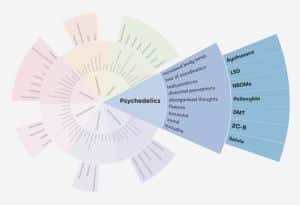
The drug wheel (psychedelics)
Common/used types of psychedelics
- LSD (Lysergic acid diethylamide) is made from a substance found in ergot, a fungus that infects rye.
- Psilocybin is a naturally occurring substance found in mushrooms and found in many parts of the world.
- Mescaline is derived from the Mexican Peyote and San Pedro cactus and has similar effects to LSD.
- DMT (Diemethyltryptamine) is structurally similar to psilocin, an alkaloid found in psilocybin mushrooms. It can be synthesized in the laboratory, but is also a naturally occurring constituent of several plants.
- 2C-B (4-Bromo-2,5-dimethoxyphenethylamine) is a psychedelic drug first synthesized in 1974. 2C-B is considered both a psychedelic and a mild entactogen. "Entactogenic" means "touching inside" and is a term used by psychiatrists to classify MDMA and related drugs.
- Peyote (Lophophora williamsii) is the best known and most powerful psychedelic cactus, although the smallest and slowest growing. Instead of growing upward into a column, it grows as "buds" low to the ground. It has been used for more than 5,000 years by Native Americans
Learn more
These are by no means all psychedelics. For more information about the (chemical) composition, stories of experience, legislation and dosage, please refer to the website Erowid.org - Psychoactive Plants & Drugs.Where does the word "psychedelics" come from and what does it mean?
The word “psychedelica” is a contraction of the Greek words“psyche”and“deloun,” which literally means “to makethe mind visible.”
Although "psychedelics" is the most commonly used name today, these substances have also been known by many other names throughout time. The variety of terms shows that the range of effects that psychedelics can cause is broad and complex.
Phantastica
One of the first names was “phantastica”—coined in the early 20th century and derived from the same root as “fantastic.” It emphasized the visionary and mystical nature of psychedelics.Hallucinogens
The term “hallucinogens” first appeared in the 1950s. It emphasizes that psychedelics can induce hallucinations (which are sensory perceptions not directly linked to an external stimulus; for example, you see, hear, or smell things that aren’t actually there, or that distort physical reality).Psychotomimetics
"Psychotomimetics" literally means "mimicking psychosis." It is a very limiting term, as it emphasizes only one aspect of psychedelics. The word "psychosis" conjures up a negative image. Although psychedelics can briefly induce such states, equating the experience with psychosis is misleading.Entheogens
The term “entheogens” emerged in the 1970s, meaning “to generate the divine within oneself.” This term emphasizes the ability of psychedelics to produce spiritual, religious, and mystical experiences. Entheogens refer directly to these experiences.Empathogens and entactogens
Finally, in the 1980s, the terms “empathogens” and “entactogens” emerged. These were (and are) used to describe substances such as MDMA. Although not classic psychedelics, they emphasize the ability to achieve or feel a deeper connection with others.There is no perfect term to encompass the full breadth of psychedelic substances.
What is psilocybin?
Psilocybin and psilocin are substances found in magic mushrooms and certain types of truffles. Psilocybin produces mind-altering effects. The effects vary from person to person, but hallucinations are common, and it can affect your mood and thoughts. The experience is often positive, but sometimes it isn’t. In that case, it’s referred to as a “bad trip.”
The effects of psilocybin and psilocin last about 4 to 6 hours.
What is LSD?
Lysergic acid di-ethylamide (C20H25N3O), also known as LSD-25, is an organic compound with hallucinogenic effects. It was first synthesized in 1938 by Swiss Albert Hofmann from the ergot alkaloids of the cereal fungus ergot.
LSD is an abbreviation of the German word Lysergsäure-diäthylamid. In Dutch, it is translated as lysergic acid diethylamide.
A special property of LSD is that it exhibits psychoactive effects even when taken in very small amounts (25 micrograms - 25-millionths of a gram). In the 20th century, LSD was used worldwide by psychiatrists to treat mental illnesses such as psychosis (e.g., schizophrenia).
The popularity of lsd peaked in the 1960s and declined rapidly after the drug was first criminalized nationally and then by the United Nations in 1971. The 21st century has seen a rise in interest in the microdosing and therapeutic application of lsd.
LSD was classified by researchers at the National Institute for Public Health and the Environment in 2009 as a relatively harmless drug; addiction or overdose is virtually impossible and the risks are mainly limited to the possibility of a very unpleasant bad trip, which can be prevented by proper preparation(set and setting).
Please note: The possession, use, and production of LSD are prohibited in almost all countries. LSD is not recommended for people with (a predisposition to) psychiatric disorders or during pregnancy.
See also:
Is microdosing safe?
What is 1p-LSD?
Possible side effects
How psychedelics were bannedHas any research been done on psychedelics?
Yes, there have been many studies on psychedelics and in particular LSD and psilocybin over time. Soon after the discovery of LSD by Hofmann in 1943, the medical community plunged into researching psychedelics.In recent years, more and more research has been done on psychedelics.See, for example, UMC Utrecht- Psychedelics against depression and this video about research on the effects of Ayahuasca on depression, conducted by Maastricht University. And Worldwide action against the taboo around psychedelics (VRT News).
What microdosing regimens (protocols) are there?
The two best-known protocols are the Fadiman microdose protocol and the Stamets microdosing protocol .
More info:
Everything You Need to Know About Choosing a Microdosing Protocol
A Guide to MicrodosingWhy should I include breaks in my microdosing regimen?
Microdosing is mainly a matter of “less is more.” It is therefore advisable to take a break every now and then.
During a rest period, you'll have time to process and integrate the insights you experienced while microdosing.
Can I drive a car while microdosing?
Like LSD, magic mushrooms and truffles contain psychoactive compounds that can affect perception, mood and cognitive processes, even at small doses. Although the effects in microdosing are very subtle, they can sometimes lead to (temporary, intermittent) decreased alertness, absent-mindedness and reduced reaction times - all critical factors during activities such as driving a car or operating a forklift.
We do not recommend driving on microdosing days when you are microdosing with psychedelics, and this applies even more so to people who have little or no experience with the effects of microdosing.
See also:
Driving and microdosingCan I drink alcohol while microdosing?
Combining microdosing with alcohol or other substances can have unpredictable effects. Alcohol can affect perception, judgment, mood, and physical performance. We do not recommend combining these substances.
I get nauseous from microdosing, what can I do about it?
Nausea sometimes occurs in people who microdose with psychedelics. To prevent or reduce nausea, drinking fresh ginger tea may help.
I get tired when I microdose. Is that normal?
Fatigue with microdosing occurs mostly with truffles and to a lesser extent with magic mushrooms (this side effect is reported by people with some regularity).
You may also experience (episodes of) fatigue when microdosing LSD or 1P-LSD, but this effect is rare with (1P)LSD. If you do experience it, it may very well be that you are actually (over)tired, but that you notice it less or not at all in your normal daily life, or (unconsciously) do not allow yourself to acknowledge it.
See also:
Possible side effects of microdosingI sometimes get scared, stressed or hypersensitive when I microdose. What can I do about that?
Anxiety, stress, or hypersensitivity are signs you should take seriously. Microdosing is often described as a subtle experience, but that doesn’t mean every experience is pleasant or appropriate. Mood, sleep, busyness, physical exertion, medication, and combining substances can all affect how a person feels.
If you feel restless, anxious, or overwhelmed, exercise caution. Stop if symptoms persist or become severe, and contact a doctor or qualified professional—especially if you have mental health issues, are taking medication, or are unsure.
Microvibes does not provide personalized advice on use or dosage, nor does it recommend adjusting dosages or switching to a different product. Please also read the information on interactions with other products.
See also:
Possible side effects of microdosingWhat happens if I accidentally take a "microdose" that is (much) too high?
If you take too high a dose (for example, if you forgot that you’d already taken your microdose and take it again), you may start to feel the physical and/or mental effects of the substance you’re microdosing with.
Effects you may then begin to feel include hot/cold waves through your body, mild hallucination, temporary confusion (for example, simple actions suddenly become very complex) and nausea/fatigue (with psilocybin).
If someone experiences unexpectedly strong or unpleasant effects, it is important to remain calm, find a safe place, and not take any additional substances. If you experience panic, confusion, physical symptoms, or have any doubts, contact a doctor, an after-hours medical service, or the emergency department.
I suffer from psychosis, schizophrenia or other psychological symptoms. Can I microdose?
People with mental health disorders and a predisposition to conditions such as schizophrenia or psychosis should exercise extra caution when using psychedelics, including when microdosing. The use of psychedelics when experiencing mental health issues can have serious consequences.
Be sure to consult your primary care physician or healthcare professional before considering microdosing.
See also:
Microdosing for Mental Health IssuesI have epilepsy. Can I microdose safely?
The use of psychedelics in cases of epilepsy can have serious consequences. Psychedelics are known to trigger epileptic seizures.
Be sure to consult your primary care physician or healthcare professional before considering microdosing.
See also:
Microdosing and SafetyI have Tinnitus. Is this a risk with microdosing?
Tinnitus (ringing in the ears) may temporarily get worse, but this is not always the case. Personal experiences vary greatly.
What is known about microdosing in combination with other substances (drugs) or medications?
Combining psychedelics with medication, alcohol, cannabis, stimulants, or other psychoactive substances can have unpredictable effects and increase the risks.
This is certainly true for antidepressants, antipsychotics, lithium, tramadol, MAO inhibitors, antiepileptic drugs, ADHD medications, strong pain medications, and drugs that affect mood, blood pressure, or the nervous system.
Are you taking any medications or other substances? Always discuss this with a doctor or healthcare provider. Never stop or change your prescribed medication on your own.
See also:
Microdosing and Medication
In which countries are magic mushrooms and/or truffles (psilocybin) legal?
Mushrooms and truffles are partially prohibited substances in the Netherlands. The sale and possession of psilocybin-containing mushrooms is not legal, but the sale and possession of psilocybin-containing truffles is legal.
So, you can buy truffles at smart shops or online stores, but not magic mushrooms. However, you can legally purchase grow kits that allow you to grow magic mushrooms yourself quickly and easily. But as soon as the mushrooms emerge from the ground, they are technically illegal again.
For a complete overview of laws in other countries, go to Legality of psilocybin (magic mushrooms and truffles).
Why are psychedelics banned?
There are a variety of reasons why most psychedelics are banned. Sometimes it is related to perceived or demonstrated health risks, sometimes there are "political" reasons, and sometimes legal bans give the impression of official unwillingness and arbitrariness.
I am going abroad and want to take my microdosing with me. Is that allowed?
Even if the rules surrounding microdosing and psychedelics are not too bad in the country you are traveling to, you can still get into trouble at customs at airports if you have something with you that they can't identify or that is questionable.
Our advice is: don't do it!
Also read:
Where are psychedelics legal?
Want to buy a microdosing kit?
Check out all products and current promotions in the online store.