

A new wind is blowing through the world of psychedelics. What for decades was seen as dangerous, forbidden and taboo is increasingly proving to be a source of insight, healing and scientific curiosity.
Psychedelics - substances like LSD, magic mushrooms, truffles and MDMA - are about to regain their place in medicine. And yet: in criminal law, they are still treated as a crime, as if they threaten society.
The history of psychedelics
The use of psychedelics is as old as humanity itself. In virtually every culture on Earth, there are rituals in which plants or fungi are used to expand consciousness, heal the soul, or connect with the divine.
In the Amazon, ayahuasca has been consumed for thousands of years; in Mexico, psilocybin-containing mushrooms were revered by the Mazatec shamans; and in North America, indigenous peoples used the peyote cactus as a sacred sacrament.
According to the Stoned Ape Theory proposed by the well-known “psychedelic advocate” Terence McKenna, our distant ancestors may have already been consuming magic mushrooms that grew in the wild. The idea is that these early encounters with psychedelics may have played a role in the accelerated development of language, creativity, and consciousness—and thus in the evolution of modern humans.
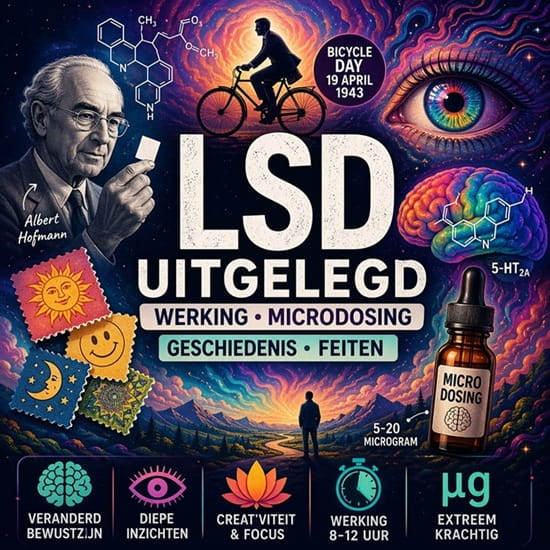
In the 1940s and 1950s, interest in psychedelics revived. When Swiss chemist Albert Hofmann accidentally discovered the psychoactive effects of LSD in 1943, it was the beginning of a completely new chapter in Western psychiatry.
At the time, psychologists and psychiatrists used LSD as an aid in psychotherapy, trauma treatment, and addiction treatment, and artists and intellectuals also experimented with it to deepen their insight and creativity.
In the 1960s, use blew over to the general public. LSD became the symbol of counterculture: the hippie movement, flower power, and artists such as The Beatles, Jefferson Airplane and Pink Floyd sang openly about their experiences with mind-altering drugs.
At the time, psychedelics represented not only a mind-expanding experience, but also social change—freedom, peace, and a different way of thinking. That cultural explosion sparked fear among governments, which feared that psychedelics would undermine authority and order. And so began the long period of repression that virtually brought scientific research to a standstill.
Half a century later, we see the consequences: millions of people struggling with depression or addiction, while potentially effective therapies, (self)medication and research with psychedelics are banned.

The 'Stoned Ape' theory
How psychedelics were banned
Psychedelics were banned by the (U.S.) government in the 1960s. President Richard Nixon even called LSD a danger to the state. When activists in the Netherlands ("Provo's") in 1966 threatened to disrupt the royal wedding between Princess Beatrix and Claus von Amsberg by feeding sugar cubes containing LSD to police horses, the government panicked and it was quickly put on the Opium list in our country as well.
Along with this ban, all promising research into the possibilities of psychedelic therapy was also stopped. Media campaigns were launched to scare the people about the risks of psychedelics (see, for example, this video and this video).
And so countless fables and misconceptions have arisen about perhaps one of Mother Nature's greatest miracles: psychedelics.
Still, the prohibition of psychedelics has not prevented these healing substances from regaining plenty of interest. In more and more countries, the use of psychedelics is now allowed again (albeit sparsely or only in therapeutic settings), or there are plans to legalize them. Fortunately, there is also plenty of research being done on psychedelics and their possible medical and therapeutic applications.
The benefits of psychedelics and the call for legalization are so compelling that it will become increasingly difficult for the government to maintain the legal ban. Moreover, nearly every study confirms what experienced users have known for a long time: that psychedelics do not belong in the criminal justice system, but rather in the doctor’s medicine cabinet, on the therapist’s desk, and in the display case of a smart shop.
A means, not a crime
The wry thing is that many of the dangers surrounding psychedelics stem precisely from prohibition itself.
Because use has been pushed to the margins, quality control, guidance and education are lacking. Anyone struggling with trauma or depression today may take a cocktail of antidepressants, sleep aids and tranquilizer pills without a problem - but risks prosecution if they choose a natural molecule that has been found in mushrooms for millions of years.
The idea that psychedelics would be a crime doesn't hold up once you look at the facts.
There is absolutely no scientific evidence that the controlled use of substances such as LSD or psilocybin causes structural damage or is addictive. On the contrary: they have low or no toxicity, no physical addiction potential, and can even lead to lasting behavioral improvements, provided they are used properly.
They are tools that, in the right context, enhance self-reflection, empathy and connection - traits that could heal rather than harm society.
The real problem lies not in the substance itself, but in the way policy looks at it. By criminalizing psychedelics, we criminalize curiosity, healing and self-exploration. We are putting people who seek help in the corner of "criminals," when in fact they are often seeking meaning, recovery or relief from mental suffering.
This is not only counterproductive, but ethically untenable at a time when science shows time and again that these substances, under supervision, actually lead to less suffering.
So the question is no longer whether psychedelics have therapeutic potential.
The question is: how many more people must we let suffer before policy catches up with science—and humanity?
The future of psychedelics
What we see in recent years (since about 2010) is not a return to old rituals, but a new phase of scientific and social acceptance.
Governments and research institutes are once again investing (albeit modestly) in understanding the therapeutic value of psychedelics. Within the European Union, grants are being awarded for clinical research into psilocybin and other mind-expanding substances, and interest is also growing within the academic community in the Netherlands.
Institutions such as the University Medical Center Utrecht, Radboud University Nijmegen, and Maastricht University are conducting studies on the use of psilocybin to treat depression, anxiety disorders, and addiction. The tone of the public debate is visibly shifting: psychedelics are increasingly being discussed at medical conferences, in policy documents, and in the media—not as a drug problem, but as a potential medicine.
It is expected that psychedelics will become part of mainstream therapeutic and psychiatric treatments within the next ten years—not as a miracle cure, but as a catalyst for insight, behavioral change, and recovery.
And perhaps we will then look back on this era and ask ourselves: how could we ever have thought that criminal law knew better than science what healing is?
Recent studies
Dozens of peer-reviewed studies have appeared in recent years, opening the door to a new therapeutic era. Below is a selection of the most influential studies:
Psilocybin for Major Depressive Disorder (JAMA Psychiatry, 2021) — A clinical trial in adults with MDD showed rapid and sustained improvement in depressive symptoms following psilocybin-assisted therapy.
Psilocybin vs. escitalopram (NEJM, 2021) — A double-blind study compared psilocybin with a commonly used antidepressant. The results: comparable effectiveness, but psilocybin showed greater improvements on secondary measures such as well-being and quality of life.
Single-dose psilocybin for depression (JAMA, 2023) — A single supervised dose led to rapid symptom relief with a favorable safety profile; follow-up research on long-term effects is ongoing.
Psilocybin for Alcohol Addiction (JAMA Psychiatry, 2022) — In a randomized trial involving 93 participants, patients who received psilocybin drank significantly less heavily than the placebo group.
MDMA-assisted therapy for PTSD (Nature Medicine) — Phase 3 studies show that MDMA, when combined with psychotherapy, significantly reduced PTSD symptoms and was generally well tolerated.
Psilocybin and Smoking Cessation (Johns Hopkins, 2014–2021) — A pilot study and follow-up showed unusually high abstinence rates among smokers who received psilocybin in combination with therapy.
LSD for Anxiety and Cluster Headaches (Switzerland, 2014–2024) — Studies indicate a clear reduction in anxiety and headache frequency with low- to moderate-dose LSD, along with a favorable safety profile.
Australia & Canada as Pioneers (2023–2025) — Through reclassification and special authorization programs, doctors can prescribe or supervise psychedelic therapy, yielding practical clinical data outside the laboratory.
How strong is the research?
💪 Strong: MDMA in PTSD, psilocybin in depression
Multiple Phase 3 studies show that MDMA-assisted therapy significantly reduces PTSD - even in patients who were therapy-resistant for years. Similarly, psilocybin showed rapid and sustained improvement in major depression in controlled studies. Both treatments have now received breakthrough therapy status.
🌱 Promising: Psilocybin in addiction and anxiety disorders, LSD in existential anxiety and cluster headaches
Research suggests that psychedelics may have broader applications. Psilocybin reduced alcohol and nicotine addiction, LSD-assisted therapy showed improved anxiety and pain scores in terminally ill patients, and there is evidence of relief in migraine and cluster headaches.
🔬 Early stage: Microdosing, neurodegenerative disorders, cognitive performance
Microdosing with LSD or psilocybin reveals interesting patterns in moodhttps://microvibes.nl/microdosing-handleiding-lsd/ing, and focus. In addition, experimental research is underway on neuroplasticity and anti-inflammation in the brain, with potential applications for Alzheimer’s and Parkinson’s—a fascinating but nascent field of research.
From prohibition to connection
The discussion about psychedelics is bigger than just drug policy.
It is about our view of mental health, of freedom, and of the role of consciousness in our lives.
Psychedelics do not belong in the prison of fear, but in the toolbox of understanding.
If we have learned anything from the past few decades, it is this:
where fear closed the door, knowledge opens it again.
💭 "What was once forbidden out of fear can now be healed through insight."
- Microvibes
More blogs

Want to buy microdoses?
Check out all products and current promotions in the online store.