
This page is intended as an informative overview. We discuss the background, nomenclature, chemical context, and related tryptamines. We do not provide instructions for use, dosage recommendations, or medical or therapeutic claims.
In a nutshell: What is 4-HO-MET?
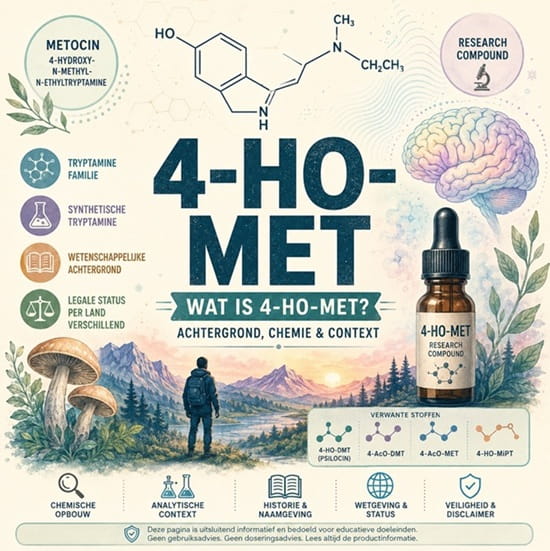
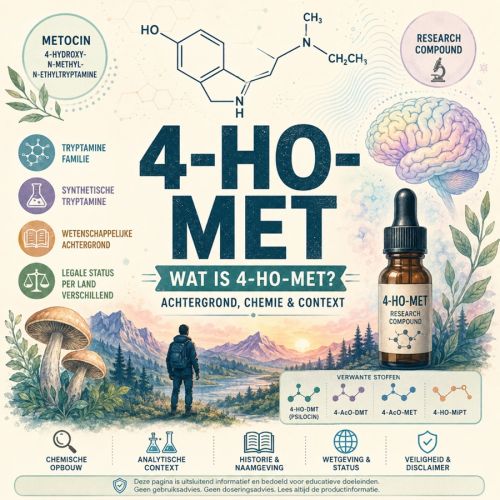
4-HO-MET is a research compound in the tryptamine family. Chemically, it is related to psilocin, also known as 4-HO-DMT, but it is not the same molecule. The difference lies primarily in the substitution on the nitrogen group: whereas psilocin contains two methyl groups, 4-HO-MET has one methyl group and one ethyl group. As a result, 4-HO-MET has its own chemical identity and its own analytical profile.
In analytical and forensic contexts, 4-HO-MET is often discussed as a new psychoactive substance, or NPS for short. This means that the substance is part of a broader group of relatively new compounds that may be structurally related to better-known substances, but for which public knowledge, long-term data, and legal assessments may vary by country.
What does the name 4-HO-MET stand for?
The name 4-HO-MET describes the structure of the molecule.
4-HO refers to a hydroxyl group at the fourth position of the indole ring.
MET stands for N-methyl-N-ethyltryptamine.
Together, these form: 4-hydroxy-N-methyl-N-ethyltryptamine.
The nickname “Metocin” is used primarily in online and niche contexts. Another name that sometimes comes up is “Methylcybin,” although 4-HO-MET is usually more widely recognized by the abbreviation 4-HO-MET in professional or analytical contexts. The UNODC lists 4-HO-MET, 4-OH-MET, Metocin, and Methylcybin, among others, as names for the same substance.
Why is 4-HO-MET often compared to psilocybin?
4-HO-MET is often mentioned in connection with psilocin/psilocybin because both substances belong to the 4-hydroxytryptamine class. Psilocin is chemically known as 4-HO-DMT. 4-HO-MET has the same 4-hydroxy base but differs in its N-substitution. As a result, it is not psilocin, but it is a related tryptamine within the same broader chemical category.
Microdosing
Truffles, 1p-LSD spray, and 4-HO-MET.
Magic truffles
Cultivated with care to perfection.
Botanicals & Fragrances
Lotus, caapi, smokes, scents, and more.
Stamps
1p-LSD and AL-LAD stamps.
Research compounds
Lysergamides and tryptamines.
The chemical family: 4-substituted tryptamines
4-HO-MET belongs to the broader group of 4-substituted tryptamines. These are compounds in which a specific group, such as a hydroxyl group or an acetoxy group, is attached to the fourth position of the tryptamine structure.
Well-known related names include:
4-HO-DMT
Better known as psilocin. This is a well-known reference compound within the tryptamine family.
4-AcO-DMT
An acetoxy variant that is often discussed in the same chemical context as 4-HO-DMT.
4-AcO-MET
The acetoxy variant of MET. In an analytical context, 4-AcO-MET is often mentioned alongside 4-HO-MET, because acetoxy compounds can be relevant to metabolism and detection under certain circumstances. In a forensic publication, 4-AcO-MET was described as the acetate ester of 4-HO-MET.
4-HO-MiPT
Also known as Miprocin. Another 4-hydroxytryptamine with its own structure and name.
N-methyl-N-ethyltryptamine. 4-HO-MET can be considered the 4-hydroxy variant of MET.
Because of these connections, 4-HO-MET is often discussed within broader fields of study related to tryptamines, NPS, analytical chemistry, and research compounds.
Is 4-HO-MET natural or synthetic?
4-HO-MET is generally described as a synthetic tryptamine. This means that the substance should not simply be equated with natural tryptamines found in mushrooms or plants. Although tryptamines, as a chemical family, include both natural and synthetic compounds, 4-HO-MET is primarily known as a research compound in the context of new psychoactive substances (NPS).
That distinction is important. In online stores, forums, or informal texts, the terms are sometimes used interchangeably, but for a precise explanation, it is better to describe 4-HO-MET as a synthetic tryptamine structurally related to other 4-hydroxytryptamines.
Why is 4-HO-MET of interest to researchers?
4-HO-MET is of interest from an analytical and forensic perspective because it demonstrates how small changes in a tryptamine structure lead to a new compound with its own name, profile, and detection challenges.
Research on 4-HO-MET focuses, among other things, on:
identifying the substance in samples;
distinguishing between related tryptamines;
metabolism and breakdown products;
analytical methods such as LC-MS, GC-MS, and HRMS;
broader monitoring of new psychoactive substances.
In a study on the metabolism of 4-HO-MET, the substance was described as a new psychoactive substance within the chemical class of tryptamines. Such publications are particularly relevant for laboratories, toxicologists, and agencies that monitor the NPS market.
4-HO-MET and legislation
The legal status of 4-HO-MET may vary by country and may change over time. In the Netherlands, a List IA was added to the Opium Act on July 1, 2025, for certain groups of new psychoactive substances. The national government lists, among others, phenethylamines (including cathinones), synthetic cannabinoids, and fentanyl-like substances as substance groups covered by that ban.
That does not mean you can automatically draw conclusions about every individual tryptamine based on a single general text. Therefore, always check current legislation, product information, and any updates from official authorities. This page is intended for informational purposes only and does not constitute legal advice.
Is 4-HO-MET the same as 4-AcO-MET?
No. 4-HO-MET and 4-AcO-MET are not the same molecule. They are, however, chemically related. 4-AcO-MET is the acetoxy variant, while 4-HO-MET is the hydroxy variant. In analytical and forensic contexts, these substances are often discussed together because related tryptamines are important for the identification and interpretation of samples.
An easy way to remember the difference:
4-HO-MET = hydroxy variant
4-AcO-MET = acetoxy variant
Laboratory analysis is required for accurate identification. Names, product labels, or informal descriptions are not sufficient for this purpose.
Why is reliable information about 4-HO-MET limited?
For relatively new research compounds, the available information is often scattered. Some of it comes from scientific literature, some from forensic cases, some from monitoring reports, and some from niche online sources. Not all of these sources are equally reliable.
For example, online experiences or forum posts are no substitute for peer-reviewed research. They often provide no certainty regarding composition, purity, context, combinations, or individual differences. Therefore, when it comes to 4-HO-MET, it is wise to rely primarily on analytical sources, scientific publications, and up-to-date product information.
Summary
4-HO-MET is a synthetic tryptamine also known as Metocin. Its full name is 4-hydroxy-N-methyl-N-ethyltryptamine. The substance belongs to the group of 4-substituted tryptamines and is often discussed alongside related compounds such as 4-HO-DMT, 4-AcO-DMT, 4-AcO-MET, and 4-HO-MiPT.
The relevance of 4-HO-MET lies primarily in the chemical and analytical context: it is a research compound with its own structure, its own nomenclature, and its own place within the broader discussion of NPS. For readers interested in tryptamines, 4-HO-MET is particularly interesting as an example of how subtle molecular variations can lead to new substances, new detection challenges, and shifting legal assessments.
This page is intended to provide educational background information. It does not contain any usage recommendations, dosage recommendations, or medical or therapeutic claims.
Want to buy research compounds?
Check out all products and current promotions in the online store.