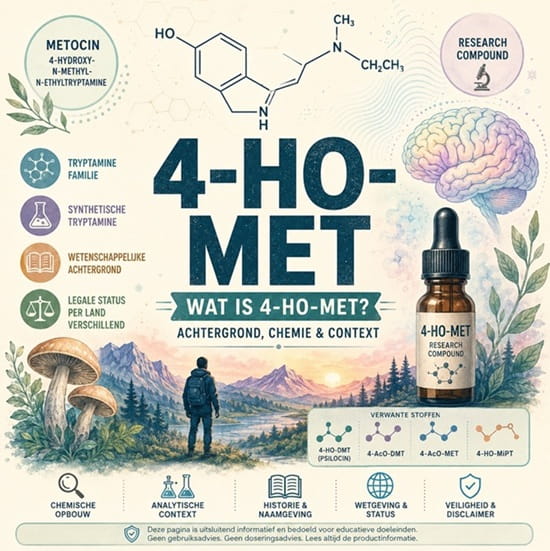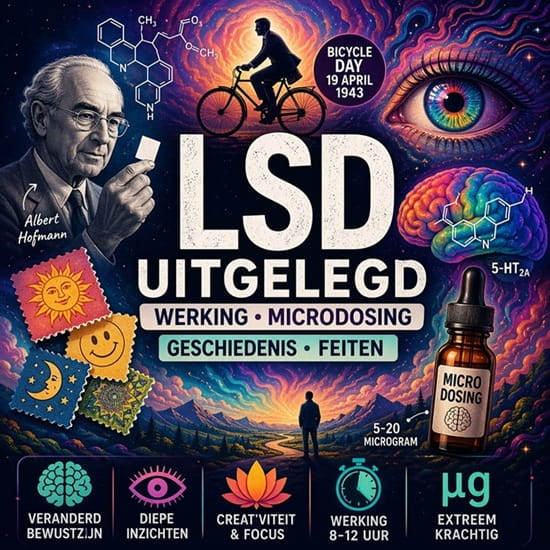

But what exactly is LSD? How does it work? Why do some people microdose? And how is it possible that a substance dosed in micrograms (millionths of a gram) can have such a powerful effect?
In this article, we’ll take you through the history, effects, and interesting facts about LSD.
The discovery of LSD
LSD was first synthesized in 1938 by the Swiss chemist Albert Hofmann. At the time, he was working at the pharmaceutical company Sandoz in Basel and was researching substances that might have medicinal applications.
It wasn't until several years later, on April 19, 1943, that Hofmann discovered the substance had a powerful effect on consciousness. On that day, he took a small amount of LSD for the first time to test its effects.
While cycling home from work, the LSD began to take effect, and he became the first person to experience its effects. An experience that would later become legendary, as psychedelic enthusiasts around the world still celebrate this day as Bicycle Day.
Where does LSD actually come from?
Although LSD is produced in a laboratory, its source is derived from lysergic acid, which is found in ergot. Ergot is a fungus that grows on grains such as rye. LSD is therefore semi-synthetic and, contrary to what many people believe, not entirely synthetic.
Rye ergot has been known in medicine and folklore for centuries. Some historians even believe that ergot poisoning may have played a role in certain historical events, such as mass hysteria in the Middle Ages. It is believed that this occurred when bakers baked bread using grains contaminated with ergot (the fungus).
Albert Hofmann succeeded in synthesizing a new substance from this fungus: lysergic acid diethylamide, better known as LSD.
(text continues below)
Test your knowledge of LSD
Join us and receive a gift
Take the Microvibes LSD quiz and find out how much you know about LSD. At the end, you'll see your score right away, and a fun little gift is waiting for you.
How does LSD affect the brain?
Although LSD has been known for more than eighty years, scientists still do not fully understand exactly how it works. What we do know by now is that LSD affects various systems in the brain—particularly the serotonin receptors, which influence mood and emotion, perception, motivation, sleep, energy, and cognitive flexibility, among other things.
LSD appears to bind particularly strongly to the 5-HT2A serotonin receptor. This interaction alters communication between different areas of the brain. Networks that normally function quite independently suddenly begin to communicate with each other more intensively.
That is one of the reasons why people often experience new perspectives, insights, or creative ideas during an LSD trip, but also why they can “taste music” and “hear colors” (these are anecdotal experiences).
The Default Mode Network (DMN)
One of the most significant findings from modern psychedelic research concerns a brain network known as the Default Mode Network (DMN) — often referred to as the default mode network.
This network is active when you are not actively engaged in a specific task. For example, when you are daydreaming, reflecting on yourself, reminiscing, worrying, or thinking about the future.
The DMN plays an important role in self-reflection and our sense of identity. In a sense, the network forms the neurological basis of what we often call the ego.
Research shows that psychedelics such as LSD can reduce activity in this network.
Why that's interesting
When the Default Mode Network becomes temporarily less active, it appears that more space opens up for communication between other brain regions. Brain regions that normally “talk” to each other less suddenly begin to form new connections.
This can have various effects: new perspectives on problems, more creative thinking, breaking out of fixed patterns of thought, and
a sense of connection with others or the environment
Many researchers believe that this may also be one reason why psychedelics could be useful in treating conditions such as depression, anxiety disorders, addiction, and trauma.
In some of these conditions, the Default Mode Network appears to be overactive, which can lead to excessive worrying or getting stuck in negative thought patterns. By temporarily reducing the activity of this network, space can be created for new perspectives and insights.
LSD and the psychedelic revolution of the 1960s
Although LSD was discovered as early as the 1940s, it didn't really gain widespread attention until the 1960s.
During that time, it became an important symbol of the counterculture. Artists, writers, and musicians experimented with psychedelics to explore their creativity and consciousness.
One of the most famous cultural references to LSD is the Beatles song“Lucy in the Sky with Diamonds.” Although the band has always claimed that the song was inspired by a child’s drawing, it was soon associated with LSD.
That’s also where a well-known street name comes from: Lucy.
In addition to Lucy, LSD is also often simply called “acid.”
What is an LSD trip like?
At higher doses, LSD can have a very intense mind-altering effect. The experience can vary greatly from person to person and is influenced by factors such as mood, environment, and expectations—often referred to as "set and setting."
During an LSD experience, many people describe, among other things:
Enhanced colors and patterns
Colors appear brighter and more vibrant, and ordinary objects can take on a special beauty
A Changed Sense of Time
Minutes can feel like hours, while hours sometimes seem to fly by
Deeper introspection
Thoughts and memories can be viewed from a new perspective
Strong emotions
Feelings of wonder, connection, joy, or awe can be experienced intensely
New Perspectives on Thoughts and Ideas
People sometimes gain surprising insights into their lives, relationships, or creative work
In addition, some users report feeling a strong sense of connection with other people, nature, or the universe as a whole. For example, music may be experienced more intensely, and art, nature, or philosophical ideas may seem to take on a deeper meaning.
An LSD experience usually develops gradually. The initial effects often begin 30 to 90 minutes after ingestion, after which the intensity increases over the course of several hours. The peak of the experience often lasts several hours and is then slowly followed by a comedown phase.
Overall, an LSD experience can last quite a long time. The effects usually last about 8 to 12 hours, although some subtle aftereffects may linger a bit longer. That is one of the reasons why LSD is often considered one of the longest-lasting psychedelic experiences.
It is precisely because of this long duration that many people choose to prepare thoroughly for an LSD experience and set aside enough time and rest for it.

Why LSD is so powerful
One of the most striking characteristics of LSD is just how extremely potent it is. Even a tiny amount of this substance can have a noticeable effect on consciousness.
This is because the LSD molecule binds very strongly to certain serotonin receptors in the brain, particularly the 5-HT2A receptor. Serotonin plays an important role in processes such as mood, perception, emotions, and cognitive functions. When LSD binds to these receptors, it alters the way different brain regions communicate with one another. Networks that normally operate fairly independently begin to exchange information more intensively. This can lead to changes in perception, thinking, creativity, and self-reflection.
What makes LSD so unique is that these effects occur at extremely small doses. While many psychoactive substances are dosed in milligrams, LSD is effective even in micrograms. A microgram is one-millionth of a gram—so small that you can barely see it with the naked eye.
Because of this enormous potency, a very small amount of LSD can be used to produce a large number of doses. For example, a single gram of pure LSD can yield approximately 10,000 individual doses. This means that an amount barely visible to the naked eye could, in theory, provide thousands of psychedelic experiences.
For practical dosing purposes, LSD is therefore usually dissolved in a liquid and then applied to small pieces of absorbent paper. These pieces of paper are known as blotters or stamps. Each piece of paper typically contains a single measured dose.
Precisely because LSD is so potent, precise dosing is crucial. Even small differences in dosage can make a noticeable difference in the intensity of the experience.
Microdosing with LSD
In recent years, microdosing in particular has become popular.
With microdosing, you consume a very small amount of LSD—so small that it doesn’t cause a trip or hallucinations.
The goal of microdosing is not to experience a psychedelic trip, but to feel subtle effects while still being able to go about your daily activities. For example, many people notice a slight increase in focus, creativity, or mental clarity, without the intense perceptual changes that can occur with a full dose.
Although scientific research is still ongoing, many users report positive experiences.
How much is a microdose?
A typical LSD microdose is usually between 5 and 20 micrograms. That is an extremely small amount—after all, a microgram is one-millionth of a gram. This makes LSD one of the most potent psychoactive substances known.
By way of comparison: a full LSD experience typically involves a dose of between 100 and 200 micrograms, though some people can tolerate higher doses. A microdose is therefore usually about 5 to 10% of a standard dose.
The Fadiman microdosing regimen
A well-known microdosing regimen was popularized by psychologist James Fadiman.
Here’s how the regimen works:
Day 1: microdose
Day 2: afterglow (mild effects may still be noticeable)
Day 3: baseline (no dose)
Then repeat the cycle.
The idea behind this is that it prevents the body from building up a tolerance.
Why LSD is sometimes cited as one of the most expensive substances in the world
Because of its enormous potential, LSD is sometimes included in lists of the world’s most expensive substances. In such comparisons, LSD often ranks around third place, behind substances such as botulinum toxin and palfium chloride.
Botulinum toxin—better known as Botox—almost always ranks first. This substance is extremely potent and is used in very small amounts in both medical treatments and cosmetic applications. Certain rare pharmaceutical compounds, such as palfium chloride (a powerful painkiller), are also sometimes ranked higher.
The fact that LSD ranks so high on this list is mainly due to two factors:
– The production process is complex and requires specialized chemical knowledge and laboratory equipment.
– The substance is extremely potent: the active dose is measured in micrograms (millionths of a gram).
LSD Today and in the Future
After decades of stigma and bans, LSD seems to be slowly emerging from the shadows again in recent years. While the substance was long associated primarily with the counterculture of the 1960s, interest in LSD is now growing once more —both among researchers and among people interested in personal development and consciousness.
Although LSD is still illegal in many countries, attitudes toward psychedelics appear to be slowly changing. An increasing number of scientists, doctors, and policymakers recognize that these substances not only carry risks but can also offer potential benefits when used responsibly and in the right context.
Proponents therefore often speak of a“psychedelic renaissance”—a new era of research, openness, and curiosity about the role of mind-altering substances in science, medicine, and personal development.
It is not yet entirely clear whether LSD will play a greater role in therapy, science, or personal growth in the future. What is clear, however, is that interest in this remarkable substance is on the rise again—and that the story of LSD is likely far from over.
Want to buy microdoses?
Check out all products and current promotions in the online store.